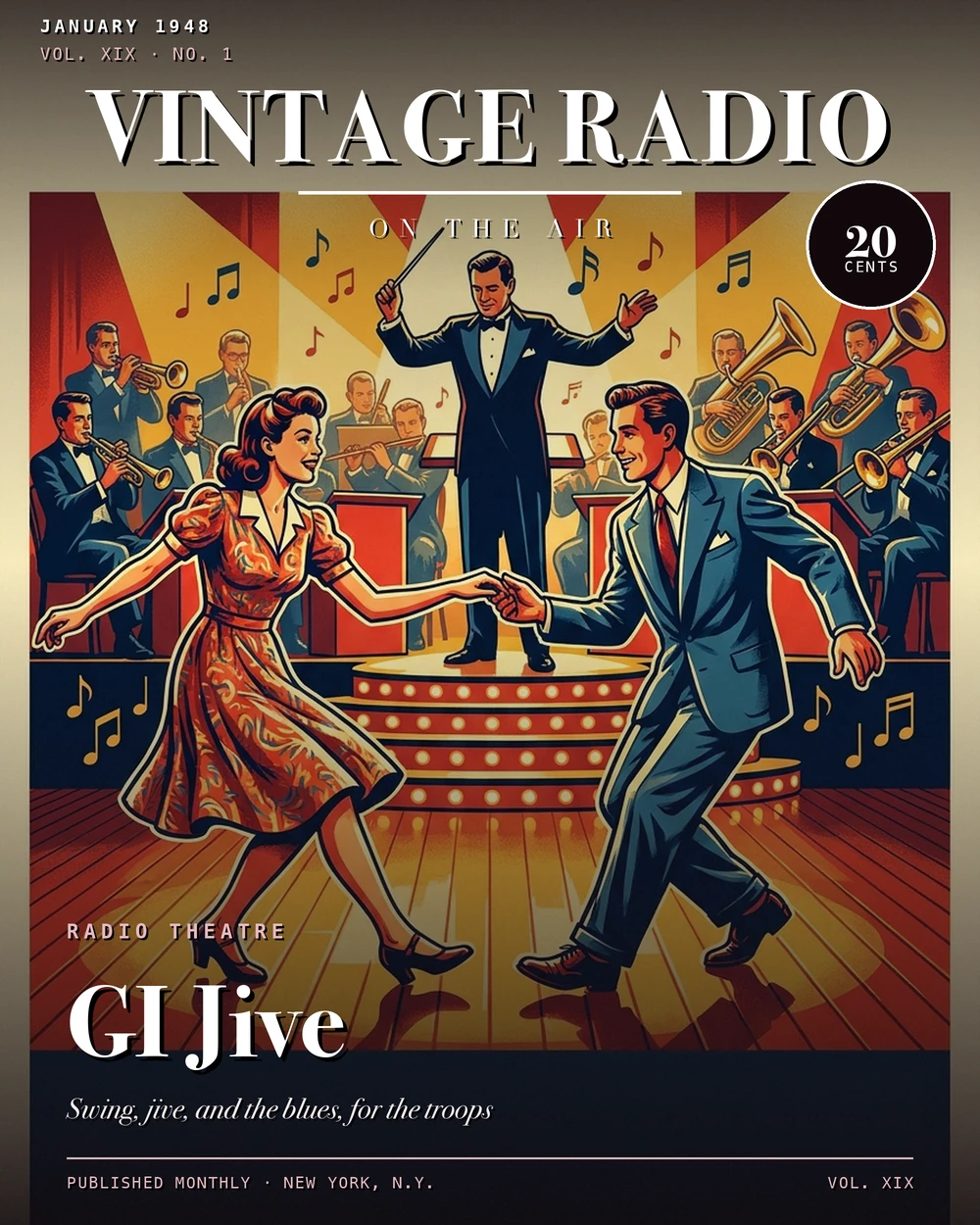
GI Jive
The Show That Reached Every Front
GI Jive was one of the founding programs of the Armed Forces Radio Service, included on the AFRS's initial production schedule from the start. It ran fifteen minutes a day, five or six days a week, and reached soldiers, sailors, and airmen across Europe, Africa, Australia, the Aleutians, and every theater in between — first by shortwave, and then by transcription discs flown out in six-day batches to stations that couldn't pick up the signal directly. The subtitle said it plainly: "AEF Jukebox of the Air."
The format was simple and deliberately so. A disc jockey played popular recordings of the day — swing, big band, blues, and 1940s pop — chatted between songs, and sometimes brought in interview guests. It was the same setup you'd find at a stateside radio station, which was exactly the point. While other AFRS programs like Command Performance and Mail Call featured live performances by big-name entertainers, GI Jive delivered the sound of the records servicemen already knew and loved, requested by letter from wherever they were stationed. Music selected from listener requests meant the playlist reflected what the troops actually wanted to hear, not what a producer in Los Angeles assumed they wanted.
Where It Came From
The program didn't start at AFRS. It began in 1942 as an Office of War Information radio show in which Martha Wilkerson and her husband Mort Werner co-hosted a program called "Jack and Jill," also known as "Hi, Neighbor." AFRS recognized the audience the show had built and took it over in the spring of 1943, moving Wilkerson to Los Angeles, where she began broadcasting daily over 400 Army radio stations.
In May 1943, Wilkerson became the program's regular host and took on the on-air name GI Jill. She never revealed her real name over the air. Few listeners knew she was married or that she had two young daughters. She was simply GI Jill — a warm, familiar voice closing every broadcast with the same line: "Good morning to some of you, good afternoon to some more of you, and to the rest of you -- good night." It was a line that acknowledged the impossible geography of her audience, spread across every time zone where American forces were fighting.
For roughly the first 600 episodes, before Wilkerson took over full-time, guest DJs hosted the show. That group included Hollywood actresses Virginia Gilmore, Jane Wyman, and Ann Rutherford, musician Ethel Smith, and members of the WACs and WAVEs. The rotating guest format gave the show variety in its early phase, but the consistency Wilkerson brought as a permanent host was what turned it into something troops could count on.
GI Jill
Martha Wilkerson was born May 4, 1918, in Roanoke, Virginia, and had worked at radio station KMTR in Los Angeles before her wartime broadcasting career. By the end of January 1945, she had made 870 broadcasts, and that year she was receiving one-fourth of all fan mail generated by the AFRS's 122 air shows — a remarkable share for a single program with a single host. She answered as many as 500 letters a week from servicemen and sent a photograph of herself with each reply.
Patrick Worley, writing in This Is the American Forces Network, called Wilkerson "probably the most popular performer on AFRS, and certainly the one who made the biggest impact on the troops' morale." She was sometimes compared to Tokyo Rose and Axis Sally — enemy broadcasters who used music and friendly patter to demoralize Allied forces — but the comparison pointed up the contrast rather than the similarity. Her programs contained no propaganda of any kind. She was the American version: same format, opposite intent.
Wilkerson's reach extended beyond the original broadcast. Her success led AFRS to train Virginia C. Claudon Allen to broadcast in India specifically to counteract Radio Tokyo transmissions. Allen became known as "the GI Jill of India" — a direct tribute to the template Wilkerson had established.
The Music
The recordings featured on GI Jive covered the major names in swing and big band: Henry James, Bob Crosby, Glenn Miller, Tommy Dorsey, Artie Shaw, Bunny Berigan, Erskine Hawkins, Count Basie, Stan Kenton, Benny Goodman, and the British bandleader Ambrose, among others. Episode titles in the surviving catalog give a sense of what those shows sounded like — Glenn Miller's "Caribbean Clipper," Artie Shaw's "Indian Love Call," Bunny Berigan's "Deed I Do," Tommy Dorsey's "Opus One" and "Moonlight On The Ganges," Count Basie's "GI Stomp," Stan Kenton's "Eager Beaver," Benny Goodman's "Get Happy."
Beyond the instrumental recordings, Wilkerson brought in interview guests who were among the biggest names in entertainment: Bing Crosby, Frank Sinatra, Bob Hope, Dinah Shore. These conversations ran alongside the records rather than replacing them, keeping the program's identity as a music show intact while giving troops occasional contact with the civilian world they'd left behind. The music itself was driven by the mail — servicemen wrote in asking for specific records, and the show played what they requested.
After the War
Martha Wilkerson lived until February 9, 1999. After her broadcasting career, she moved into writing, with screen credits that included the 1951 film Hard, Fast and Beautiful and episodes of the television series The Virginian. The wartime persona of GI Jill faded into the background of those later years, known mainly to people who had been on the receiving end of the shortwave signal.
The 82 episodes in the surviving catalog represent a portion of a run that totaled at least 870 broadcasts by early 1945, likely more before the war ended. As of 2024, GI Jive was still being broadcast nightly on a UK station dedicated to 1940s radio — a measure of how well the format holds up and how durable the music remains. Swing and big band don't require historical context to land; they just need a turntable and someone who knows how to talk between songs.